"The modern world, which denies personal guilt and admits only social crimes, which has no place for personal repentance but only public reforms, has divorced Christ from His Cross; the Bridegroom and Bride have been pulled apart. What God hath joined together, men have torn asunder. As a result, to the left is the Cross; to the right is Christ. Each has awaited new partners who will pick them up in a kind of second and adulterous union. Communism comes along and picks up the meaningless Cross; Western post-Christian civilization chooses the unscarred Christ.
"Communism has chosen the Cross in the sense that it has brought back to an egotistic world a sense of discipline, self-abnegation, surrender, hard work, study, and dedication to supra-individual goals. But the Cross without Christ is sacrifice without love. Hence, Communism has produced a society that is authoritarian, cruel, oppressive of human freedom, filled with concentration camps, firing squads, and brain-washings.
"The Western post-Christian civilization has picked up the Christ without His Cross. But a Christ without a sacrifice that reconciles the world to God is a cheap, feminized, colorless, itinerant preacher who deserves to be popular for His great Sermon on the Mount, but also merits unpopularity for what He said about His Divinity on the one hand, and divorce, judgment, and hell on the other. This sentimental Christ is patched together with a thousand commonplaces, sustained sometimes by academic etymologists who cannot see the Word for the letters, or distorted beyond personal recognition by a dogmatic principle that anything which is Divine must necessarily be a myth. Without His Cross, He becomes nothing more than a sultry precursor of democracy or a humanitarian who taught brotherhood without tears.
"The problem now is: Will the Cross, which Communism holds in its hands, find Christ before the sentimental Christ of the Western world finds the Cross? It is our belief that Russia will find the Christ before the Western world unites Christ with His Redemptive Cross."
- Archbishop Fulton Sheen (from the preface to "Life of Christ" 1958)
Showing posts with label Archbishop Sheen. Show all posts
Showing posts with label Archbishop Sheen. Show all posts
Wednesday, 1 March 2017

Friday, 3 April 2015
Lift me up
“When we are faced with our Cross, we have two choices: be like the thief on the left and say ‘Take me down,’ or be like the thief on the right and say, ‘Lift me up.’” - Archbishop Fulton Sheen
Friday, 20 March 2015
Archbishop Sheen on truth and compromise
"There are only two positions to take concerning truth, and both of them had their hearing centuries ago in the court-room of Solomon where two women claimed a babe. A babe is like truth; it is one; it is whole; it is organic and it cannot be divided. The real mother of 'the babe would accept no compromise. She was intolerant about her claim. She must have the whole babe, or nothing-the intolerance of Motherhood. But the false mother was tolerant. She was willing to compromise. She was willing to divide the babe-and the babe would have met its death through broadmindedness."The Curse of Broadmindedness
Thursday, 19 March 2015
Archbishop Sheen on St Joseph
Happy Feast of St Joseph!

- The World's First Love

... The sorrow of Joseph came from the inexplicable. On the one hand, he knew that Mary had taken the vow of virginity, as he had done. It seemed impossible to believe her guilty, because of her goodness. But, on the other hand, because of her condition, how could he believe otherwise? Joseph suffered then what the mystics have called "the dark night of the soul." Mary had to pay for her honor, particularly at the end of her life, but Joseph had to pay for his at the beginning. Because Joseph had kept his vow, he was naturally surprised when he heard that Mary was with child. The surprise that Joseph felt was like that of Mary at the Annunciation: "How shall this be, seeing I know not man?" Mary wanted then to know how she could be both a virgin and a mother; Joseph wanted to know how he could be a virgin and a father.. It took an Angel to reassure them both that God had found a way. No human knowledge of science can explain such a thing. Only those who listen to Angels' voices can pierce that mystery. As Joseph had a mind to put Mary away secretly, the Gospel lifts the veil of the mystery to him: "But hardly had the thought come to his mind, when an Angel of the Lord appeared to him in a dream, and said, 'Joseph, son of David, do not be afraid to take thy wife Mary to thyself, for it is by the power of the Holy Ghost that she has conceived this child; and she will bear a son, whom thou shalt call Jesus, for He is to save His people from their sins.' " (Matt. 1:20, 21.)
Joseph's worries were overcome by a revelation of the dignity of Christ's Virgin Birth and of the nature of His mission --- namely, to save us from our sins. The very words of the Angel: "Do not be afraid to take thy wife Mary to thyself," seem to support the view that Joseph already believed that a miracle had taken place in Mary and that that was why he "feared" to bring her into his own house. It is unlikely that any man told of a Virgin Birth would ever have credited it if there had not already been in his heart a belief in the Messias, Christ, Who was to come. Joseph knew that the Messias would be born of the family of David, and he himself was of that family. He also knew of the prophecies concerning the Child, even the one of Isaias that He would be born of a Virgin. If Joseph had not already been described as a just man, the message of the Angel and the honor that was to come to Mary would have been enough to have inspired great purity in him. For if a modern father were told that one day his son would be President of the United States, it would inspire a changed attitude toward his wife, the mother of the child. In like manner, all anxiety and anguish now leave Joseph, as his soul is filled with reverence and awe for the love of Mary's secret.
That brings us to the second interesting question concerning Joseph. Was he old or young? Most of the statues and pictures which we see of Joseph today represent him as an old man with a gray beard, one who took Mary and her vow under his protection with somewhat the same detachment as a doctor would pick up a baby girl in a nursery. We have, of course, no historical evidence whatever concerning the age of Joseph. Some apocryphal accounts picture him as an old man; Fathers of the Church, after the fourth century, followed this legend rather rigidly. The painter, Guido Reni, did so when he pictured Joseph as an old man with white hair.
But when one searches for the reasons why Christian art should have pictured Joseph as aged, we discover that it was in order better to safeguard the virginity of Mary. Somehow, the assumption had crept in that senility was a better protector of virginity than adolescence. Art thus, unconsciously, made Joseph a spouse, chaste and pure by age, rather than by virtue. But this is like assuming that the best way to show that a man would never steal is to picture him without hands; it also forgets that old men can have unlawful desires, as well as young men. It was the old men in the garden who tempted Susanna. But more than that, to make Joseph out as old portrays for us a man who had little vital energy left, rather than one who, having it, kept it in chains for God's sake and for His holy purposes. To make Joseph appear pure only because his flesh had aged is like glorifying a mountain stream that has dried. The Church will not ordain a man to his priesthood who has not his vital powers. She wants men who have something to tame, rather than those who are tame because they have no energy to be wild. It should be no different with God.
Furthermore, it is reasonable to believe that Our Lord would prefer, for a foster father, someone who had made a sacrifice rather than someone who was forced to it. There is the added historical fact that the Jews frowned on a disproportionate marriage between what Shakespeare calls "crabbed age and youth"; the Talmud admits a disproportionate marriage only for widows or widowers. Finally, it seems hardly possible that God would have attached a young mother, probably about sixteen or seventeen years of age, to an old man. If He did not disdain to give His Mother to a young man, John, at the foot of the Cross, then why should He have given her an old man at the crib? A woman's love always determines the way a man loves: she is the silent educator of his virile powers. Since Mary is what might be called a "virginiser" of young men as well as women, and the greatest inspiration of Christian purity, should she not logically have begun by inspiring and virginising the first youth whom she had probably ever met --- Joseph, the Just? It was not by diminishing his power to love, but by elevating it, that she would have her first conquest, and in her own spouse, the man who was a man, and not a mere senile watchman!
Joseph was probably a young man, strong, virile, athletic, handsome, chaste, and disciplined; the kind of man one sees sometimes shepherding sheep, or piloting a plane, or working at a carpenter's bench. Instead of being a man incapable of loving, he must have been on fire with love. Just as we would give very little credit to the Blessed Mother if she had taken her vow of virginity after having been an old maid for fifty years, so neither could we give much credit to a Joseph who became her spouse because he was advanced in years. Young girls in those days, like Mary, took vows to love God uniquely, and so did young men, of whom Joseph was one so pre-eminent as to be called the "just." Instead, then, of being dried fruit to be served on the table of the King, he was rather a blossom filled with promise and power. He was not in the evening of life, but in its morning, bubbling over with energy, strength, and controlled passion.
- The World's First Love
Thursday, 17 April 2014
The Last Supper - Archbishop Sheen

Why did Our Blessed Lord use bread and wine as the elements of this Memorial? First of all, because no two substances in nature better symbolize unity than bread and wine. As bread is made from a multiplicity of grains of wheat, and wine is made from a multiplicity of grapes, so the many who believe are one in Christ. Second, no two substances in nature have to suffer more to become what they are than bread and wine. Wheat has to pass through the rigors of winter, be ground beneath the Calvary of a mill, and then subjected to purging fire before it can become bread. Grapes in their turn must be subjected to the Gethsemane of a wine press and have their life crushed from them to become wine. Thus do they symbolize the Passion and Sufferings of Christ, and the condition of Salvation, for Our Lord said that unless we die to ourselves we cannot live in Him. A third reason is that there are no two substances in nature which have more traditionally nourished man than bread and wine. In bringing these elements to the altar, men are equivalently bringing themselves. When bread and wine are taken or consumed, they are changed into man’s body and blood. But when He took bread and wine, He changed them into Himself.Life of Christ
Tuesday, 25 March 2014
The Annunciation - Archbishop Fulton Sheen
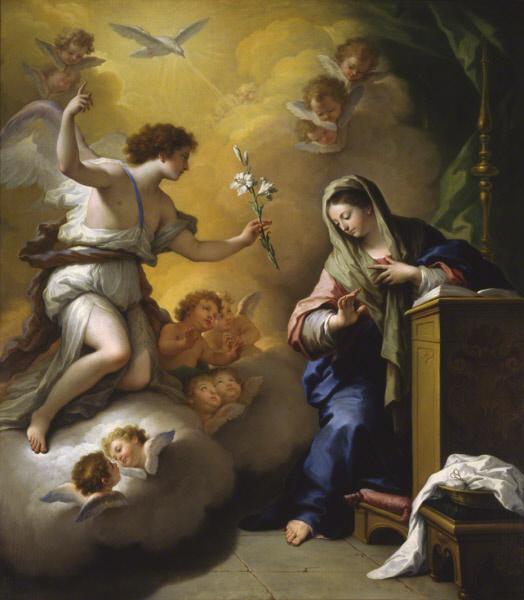
When our first parents were created, God gave them a conscience, a moral law, and an original justice. They were not compelled to follow Him as the director of the symphony of creation. Yet they chose to rebel, and that sour note of original revolution was passed on to humanity, through human generation. How could that original disorder be stopped? It could be arrested in the same way as the sour note, by having eternity come into time and lay hold of a man by force, compelling him to enter into a new order where the original gifts would be restored and harmony would be the law. But this would not be God's way, for it would mean the destruction of human freedom. God could lay hold of a note, but He could not lay hold of a man by force without abusing the greatest gift which He gave to man - namely, freedom, which alone makes love possible.
Now we come to the greatest act of freedom the world has ever known - the reversal of that free act which the Head of humanity performed in paradise when he chose non-God against God. It was the moment in which that unfortunate choice was reversed, when God in His Mercy willed to remake man and to give him a fresh start in a new birth of freedom under GOD. God could have made a perfect man to start humanity out of dust as He had done in the beginning. He could have made the new man start the new humanity from nothing, as He had done in making the world. And He could have done it without consulting humanity, but this would have been the invasion of human privilege. God would not take a man out of the world of freedom without the free act of a free being. God's way with man is not dictatorship, but cooperation. If He would redeem humanity, it would be with human consent, and not against it. God could destroy evil but only at the cost of human freedom, and that would be too high a price to pay for the destruction of dictatorship on earth to have a dictator in Heaven. Before remaking humanity, God willed to consult with humanity, so that there would be no destruction of human dignity; the particular person whom He consulted was a Woman. In the beginning, it was man who was asked to ratify the gift; this time it is a Woman. The mystery of the Incarnation is very simply that of God's asking a woman to freely give Him a human nature. In so many words, through the Angel, He was saying: "Will you make Me a man?" As from the first Adam came the first Eve, so now, in the rebirth of man's dignity, the new Adam will come from the new Eve. And in Mary's free consent we have the only human nature which was ever born in perfect liberty.
The World's First Love
Tuesday, 4 March 2014
Love is like Oxygen! - Archbishop Fulton Sheen
"Certain things that we have in us, once they are given out, are never
meant to be taken back. One is the air we breathe; if we take that air
back upon ourselves, it poisons us. Love is another. When love is
breathed out to another human heart, it is never meant to be taken back.
If it is taken back, it suffocates and poisons us."
Wednesday, 29 January 2014
Nice People - Archbishop Fulton Sheen
...
A distinction must be made between "nice" people and "awful" people.
The nice people think they are good; the awful people know they are not. The nice people never believe they do wrong, or break a commandment, or are guilty of any infraction of the moral law. If they do anything that reason would call wrong, they have various ways of explaining it away. Goodness is always their own, but badness is due to something outside of themselves. Some say that it is due to economic circumstances: one will say, "I was born too rich," and another, "I was born too poor." Psychology also comes in handy to explain away their faults, for example, "I have an Oedipus complex," or an "Electra complex."
The awful people, on the contrary, generally are not rich enough to be psycho-analysed; they have never been introduced to their subconscious; and they think themselves just plain bad. Nice people, if they are guilty of intemperance, will call themselves alcoholics. Awful people just call themselves drunkards - sometimes just plain "bums". The nice people say they have a disease. The drunkards say, "I am no good." The nice people judge themselves by the vices from which they abstain; the awful people judge themselves by the virtues from which they have fallen...
Society has no place either for those who are too good or for those who are too bad. It is only the mediocre who survive. That is why on the Hill of Calvary Our Lord was crucified with two thieves. They were too bad for conventional morality; Our Lord was too good. Often during His lifetime, Our Lord always associated with "those awful people". He tells the story of the prodigal son who was preferred before his virtuous brother. He praises a son who rebelled and repented, rather than the one who professed loyalty and then failed. He rejoices in the lost sheep that was found and the lost coin that was recovered, because the Gospel that He preached was not a condemnation of obvious badness, but rather a condemnation of obvious goodness.
...
The nice people do not find God, because, denying personal guilt, they have no need of a Redeemer. The awful people, who are passionate, sensual, warped, lonely, weak, but who nevertheless make an attemot at goodness, are quick to realise that they need another help than their own; that they cannot lift themselves by their own bootstraps. Their sins create an emptiness. From that point on, like the woman taken in sin, it is "Christ or nothing".
What surprises there will be on the Last Day when the awful people are found in the Kingdom of Heaven: "The harlots and the publicans will enter the Kingdom of Heaven before the Scribes and the Pharisees." The surprises will be threefold: first, because we are going to see a number of people there whom we never expected to see. Of some of them will we say, "How did he get here? Glory be to God, look at her!" The second surprise will be not seeing a number of the nice people whom we expected to see. But these surprises will be mild compared with the third and greatest surprise of all, and that surprise will be that we are there.
From Life Is Worth Living (Second Series).
Subscribe to:
Posts (Atom)