The First Joyful Mystery of the Rosary
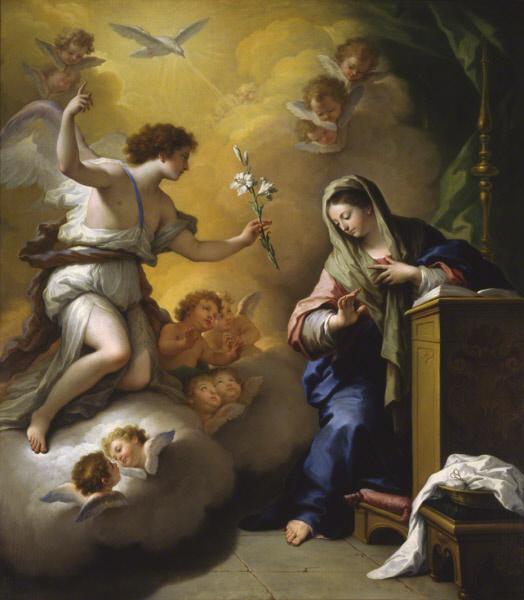
The Annunciation
1. The Rosary is both a vocal and a mental prayer. When reciting the
first five decades, we should meditate on the principal joyful mysteries
of our faith, beginning with the Annunciation to the Blessed Virgin. In
other words, during the first decade we should visualise the scene
described in the Gospel.
“The angel Gabriel was
sent from God to a town of Galilee called Nazareth, to a virgin
betrothed to a man named Joseph, of the house of David, and the Virgin’s
name was Mary. And when the Angel had come to her, he said ‘Hail, full
of grace, the Lord is with thee. Blessed art thou among women.’” (Luke
1:26-28)
Note the manner in which the Angel greets Mary. He
proclaims that she is full of grace, pleasing and acceptable to God. He
bows before her and says that she is blessed among women. On previous
occasions Angels had appeared to Patriarchs, Kings, and Prophets, but
always as superior beings bearing a command from Almighty God. Why,
then, does an Angel bow before this maiden and salute her with such
reverence? The reason is twofold. Mary is the purest of creatures,
immaculate from the moment of her conception; she is also destined to
become the Mother of God, a destiny of quasi-infinite dignity. Let us
poor sinners bow before her also and beg her to obtain for us from God
the graces of forgiveness and of sanctification. It is in this spirit of
loving humility that we should recite the first decade of the Holy
Rosary.
2. Consider now Mary’s reaction to the reverence and
praise with which the Angel greets her. Is she carried away by delight
and exaltation at this solemn moment? Nothing of the sort. In her
humility and modesty she is disturbed by the Angel’s salutation and
wonders what is the reason for it. “She was troubled at his word, and
kept pondering what manner of greeting this might be.” (Luke 1:29)
How do we behave when we receive praise from our superiors or from our
friends and acquaintances? We are pleased, and overcome perhaps by
feelings of vanity. We smile to ourselves and are convinced that we are
of more consequence than we are. We even feel the need to reveal our
thoughts to others. There is a world of difference between the
simplicity and humility of the Blessed Virgin and our vain hunger for
praise and honour.
3. The Angel reassures Mary. “Do not be
afraid, Mary, for thou hast found grace with God…” (Luke 1:30) “Thou
shalt conceive in thy womb and shalt bring forth a son… Jesus… the Son
of the Most High… the Son of God.” (Cf. Luke 1:31-36)
The
Virgin remains humble and thoughtful. She asks frankly how she can
become the Mother of God when she has resolved to remain a virgin for
the rest of her life. The Angel reveals to her the tremendous mystery by
which the Holy Spirit will descend on her and the power of the Most
High will overshadow her.
Only when Mary understood that this
was the will of God, and that the privilege of the divine Motherhood
would be compatible with the other privilege of virginal purity, did she
utter the momentous words: “Behold the handmaid of the Lord; be it done
unto me according to thy word.” (Luke 1:38)
Let us bow our
proud heads before the Virgin, the humblest and most exalted of
creatures. (Dante, Paradiso, XXXIII, 2-3) Let us learn from her to love
purity above all things and to be prepared to make any sacrifice rather
than lose this beautiful virtue.
Showing posts with label the Annunciation. Show all posts
Showing posts with label the Annunciation. Show all posts
Tuesday, 7 October 2014

Tuesday, 25 March 2014
The Annunciation - Archbishop Fulton Sheen
When our first parents were created, God gave them a conscience, a moral law, and an original justice. They were not compelled to follow Him as the director of the symphony of creation. Yet they chose to rebel, and that sour note of original revolution was passed on to humanity, through human generation. How could that original disorder be stopped? It could be arrested in the same way as the sour note, by having eternity come into time and lay hold of a man by force, compelling him to enter into a new order where the original gifts would be restored and harmony would be the law. But this would not be God's way, for it would mean the destruction of human freedom. God could lay hold of a note, but He could not lay hold of a man by force without abusing the greatest gift which He gave to man - namely, freedom, which alone makes love possible.
Now we come to the greatest act of freedom the world has ever known - the reversal of that free act which the Head of humanity performed in paradise when he chose non-God against God. It was the moment in which that unfortunate choice was reversed, when God in His Mercy willed to remake man and to give him a fresh start in a new birth of freedom under GOD. God could have made a perfect man to start humanity out of dust as He had done in the beginning. He could have made the new man start the new humanity from nothing, as He had done in making the world. And He could have done it without consulting humanity, but this would have been the invasion of human privilege. God would not take a man out of the world of freedom without the free act of a free being. God's way with man is not dictatorship, but cooperation. If He would redeem humanity, it would be with human consent, and not against it. God could destroy evil but only at the cost of human freedom, and that would be too high a price to pay for the destruction of dictatorship on earth to have a dictator in Heaven. Before remaking humanity, God willed to consult with humanity, so that there would be no destruction of human dignity; the particular person whom He consulted was a Woman. In the beginning, it was man who was asked to ratify the gift; this time it is a Woman. The mystery of the Incarnation is very simply that of God's asking a woman to freely give Him a human nature. In so many words, through the Angel, He was saying: "Will you make Me a man?" As from the first Adam came the first Eve, so now, in the rebirth of man's dignity, the new Adam will come from the new Eve. And in Mary's free consent we have the only human nature which was ever born in perfect liberty.
The World's First Love
Subscribe to:
Posts (Atom)