
Showing posts with label Mass. Show all posts
Showing posts with label Mass. Show all posts
Monday, 31 October 2016

Tuesday, 11 August 2015
The Hokey Cokey
... or Hokey Pokey, as it's known elsewhere.
(This post is apropos nothing topical, just something I've long pondered on.)
When I was young, my dad told me the Hokey Cokey mocked the Mass. The words Hokey Cokey being based on "Hoc est enim Corpus Meum" ("This is My Body"). That seems to be a well known theory, although it has been denied (for example, here).
It might all be an urban legend, but...
When I started attending Traditional Latin Masses half my life (so far) ago, it started making sense.
You put your right hand in... out, shake it all about.
- Perhaps a parody of the priest making the sign of the cross over the host and chalice at the Offertory.
You do the Hokey Cokey
- As per the famous theory, as mentioned already, about it being a parody of "Hoc est emim Corpus Meum."
And you turn around
- Priest turns to congregation and says "Dominus vobiscum."
Knees bend
- Genuflection.
Arms stretch
- Elevation.
Rah rah rah!
- Bells rung thrice.
Can those similarities really have come about just by accident?

(This post is apropos nothing topical, just something I've long pondered on.)
When I was young, my dad told me the Hokey Cokey mocked the Mass. The words Hokey Cokey being based on "Hoc est enim Corpus Meum" ("This is My Body"). That seems to be a well known theory, although it has been denied (for example, here).
It might all be an urban legend, but...
When I started attending Traditional Latin Masses half my life (so far) ago, it started making sense.
You put your right hand in... out, shake it all about.
- Perhaps a parody of the priest making the sign of the cross over the host and chalice at the Offertory.
You do the Hokey Cokey
- As per the famous theory, as mentioned already, about it being a parody of "Hoc est emim Corpus Meum."
And you turn around
- Priest turns to congregation and says "Dominus vobiscum."
Knees bend
- Genuflection.
Arms stretch
- Elevation.
Rah rah rah!
- Bells rung thrice.
Can those similarities really have come about just by accident?

Sunday, 2 August 2015
Whose preference?

The subject of the liturgy is often reduced to being a mere matter of preference, but isn't how we worship more significant than that?
One might prefer burger and fries to salad, but does that make it superior?
One could prefer the Beatles to Beethoven, while still acknowledging the superiority of the latter.
So, while one may "prefer" the New Mass or the Traditional Mass, which one is superior?
This post from last year might provide a clue.
Pomp need not come into it though. I maintain that a Traditional Mass, offered in the humblest of surroundings, without music, is still superior to a reverent New Mass in a cathedral.


(The Divine Liturgy is also superior. I often think of detergent adverts:
We washed the Latin Rite in new improved Vatican II, but we used the original formula on the
Eastern Rites. Let's see how they turned out!)
The changes matter. They matter to those who protest against them, and they matter to those who introduced them, otherwise they wouldn't have introduced them, imposing the new and suppressing the old.
The only preference which counts is God's preference. He "preferred" Abel's sacrifice to Cain's.
Saturday, 21 June 2014
The Holy Mass - Cardinal Bacci
The Holy Mass
1. The sacrifice of the Mass is the noblest act of our religion. In it is renewed in a real but unbloody manner the Sacrifice of Calvary.
Jesus desired to remain with us throughout the centuries in the Blessed Eucharist as our friend, comforter, and spiritual food. Similarly, not being satisfied with having shed His precious Blood on the Cross for our redemption, it was His wish that this sacrificial action should be renewed daily in every corner of the world in such a way that everyone could participate in it and benefit from it. When we are present at Holy Mass, therefore, we should imagine that we are on Calvary at the foot of the Cross on which our divine Redeemer is voluntarily giving His life as an innocent victim for our sins. Let us see Him hanging between earth and sky, a holocaust of propitiation between God and men. Let us see Him imploring with His dying glance forgiveness for His executioners and for us sinners.
Let us imagine, moreover, His most holy Mother as she gazes sorrowfully upon her suffering Son. With love far greater than that of any other human creature, she offers herself in union with Jesus for our salvation.
We should make a similar offering when we assist at the Sacrifice of the altar. We should sacrifice ourselves along with Jesus. If we are tormented by sufferings, let us offer them up along with those of Jesus. If we are troubled by passionate inclinations to sin, let us sacrifice these bravely along with Jesus for love of Him. If we are full of hatred and coldness towards others, let us sacrifice these feelings for love of Jesus, Who forgave everybody and prayed even for His executioners.
Let us remember that the Sacrifice of the Mass should be our sacrifice also. It is not only the priest who offers it, but we offer it along with the priest and with Jesus. "Receive, O Holy Trinity, this oblation which we make to Thee." Let us unite the offering of our entire selves to the Sacrifice of Jesus and we shall obtain great spiritual benefits.
2. Let us meditate on the fact that the Sacrifice of the Eucharist was instituted for four ends, namely:
(1) To honour God.
All the Angels and Saints of Heaven and all the human beings upon earth could not possibly honour God as He ought to be honoured, because they are creatures who derive everything which they possess from God. Only Jesus the God-Man could offer the Eternal Father the infinite honour due to Him by offering Himself.
(2) To make adequate satisfaction for all our sins.
In so far as they are a revolt against God, our sins are in a certain way infinite. This is because they offend an Infinite Being. Only Jesus, being at the same time man and God, could offer for us, His brothers, an infinite satisfaction to the Eternal Father. Only He could redeem us from the debt of crime and punishment which we had contracted by offering Himself without reserve in the Eucharistic Sacrifice. It must be explained, however, that although the Mass is of infinite value in itself, God applies this value to us in a finite way only, according to His good pleasure and according to our dispositions. For this reason we should do well to attend Mass as often as possible and with the maximum fervour.
(3) To give thanksgiving to God for all the benefits which we have received from Him.
(4) Finally, to obtain all the graces and favours of which we and other people stand in need. The Mass is an extraordinary gift. Let us attend at Mass with recollection and devotion. It will be for us the source of every grace and virtue.
3. Let us pray:
Soul of Christ, sanctify me.
Body of Christ, save me.
Blood of Christ, inebriate me.
Water flowing from the side of Christ, purify me.
Passion of Christ, strengthen me.
O my good Jesus, hear me.
Hide me within Thy wounds.
Never permit me to be separated from Thee.
From the malignant enemy defend me.
At the hour of my death call me;
And bid me to come to Thee,
That with Thy Saints I may praise Thee
For everlasting ages.
Amen.
1. The sacrifice of the Mass is the noblest act of our religion. In it is renewed in a real but unbloody manner the Sacrifice of Calvary.
Jesus desired to remain with us throughout the centuries in the Blessed Eucharist as our friend, comforter, and spiritual food. Similarly, not being satisfied with having shed His precious Blood on the Cross for our redemption, it was His wish that this sacrificial action should be renewed daily in every corner of the world in such a way that everyone could participate in it and benefit from it. When we are present at Holy Mass, therefore, we should imagine that we are on Calvary at the foot of the Cross on which our divine Redeemer is voluntarily giving His life as an innocent victim for our sins. Let us see Him hanging between earth and sky, a holocaust of propitiation between God and men. Let us see Him imploring with His dying glance forgiveness for His executioners and for us sinners.
Let us imagine, moreover, His most holy Mother as she gazes sorrowfully upon her suffering Son. With love far greater than that of any other human creature, she offers herself in union with Jesus for our salvation.
We should make a similar offering when we assist at the Sacrifice of the altar. We should sacrifice ourselves along with Jesus. If we are tormented by sufferings, let us offer them up along with those of Jesus. If we are troubled by passionate inclinations to sin, let us sacrifice these bravely along with Jesus for love of Him. If we are full of hatred and coldness towards others, let us sacrifice these feelings for love of Jesus, Who forgave everybody and prayed even for His executioners.
Let us remember that the Sacrifice of the Mass should be our sacrifice also. It is not only the priest who offers it, but we offer it along with the priest and with Jesus. "Receive, O Holy Trinity, this oblation which we make to Thee." Let us unite the offering of our entire selves to the Sacrifice of Jesus and we shall obtain great spiritual benefits.
2. Let us meditate on the fact that the Sacrifice of the Eucharist was instituted for four ends, namely:
(1) To honour God.
All the Angels and Saints of Heaven and all the human beings upon earth could not possibly honour God as He ought to be honoured, because they are creatures who derive everything which they possess from God. Only Jesus the God-Man could offer the Eternal Father the infinite honour due to Him by offering Himself.
(2) To make adequate satisfaction for all our sins.
In so far as they are a revolt against God, our sins are in a certain way infinite. This is because they offend an Infinite Being. Only Jesus, being at the same time man and God, could offer for us, His brothers, an infinite satisfaction to the Eternal Father. Only He could redeem us from the debt of crime and punishment which we had contracted by offering Himself without reserve in the Eucharistic Sacrifice. It must be explained, however, that although the Mass is of infinite value in itself, God applies this value to us in a finite way only, according to His good pleasure and according to our dispositions. For this reason we should do well to attend Mass as often as possible and with the maximum fervour.
(3) To give thanksgiving to God for all the benefits which we have received from Him.
(4) Finally, to obtain all the graces and favours of which we and other people stand in need. The Mass is an extraordinary gift. Let us attend at Mass with recollection and devotion. It will be for us the source of every grace and virtue.
3. Let us pray:
Soul of Christ, sanctify me.
Body of Christ, save me.
Blood of Christ, inebriate me.
Water flowing from the side of Christ, purify me.
Passion of Christ, strengthen me.
O my good Jesus, hear me.
Hide me within Thy wounds.
Never permit me to be separated from Thee.
From the malignant enemy defend me.
At the hour of my death call me;
And bid me to come to Thee,
That with Thy Saints I may praise Thee
For everlasting ages.
Amen.
Tuesday, 20 May 2014
How St Pius V "imposed" his liturgical reform
I was just flicking through Msgr Klaus Gamber's The Reform of the Roman Liturgy, and came upon this interesting passage, on pages 25-26:
In the Middle Ages nearly every church, or at least every diocese, had its own special Missal unless it had voluntarily adopted the Missal of the Roman Curia. No pope intervened in this matter. The parts which, more than any other, were subject to variation, were those parts of the Order of the Mass said in a low voice by the celebrant (so, the prayers at the foot of the altar, the offertory - also called the Minor Canon - and the prayers before Communion); in other words, the priest's "private prayers." On the other hand, the sung texts were almost everywhere the same within the Latin Church. Only some of the readings and prayers differed from locality to locality.Contrast that approach with the imposition of Pope Paul VI's new liturgy.
It was at this stage of development that the defense against Protestantism brought about the Council of Trent. It entrusted the pope with the publication of an amended Missal uniform for all. What exactly did St Pius V do? As I have already said, he took the Missal already in use in Rome and in many other places and he improved it, especially by reducing the number of feasts of saints. Did he make this Missal obligatory for the whole Church? No, he even respected local traditions only two hundred years old. Such a tradition was sufficient to free a diocese from the obligation of using the "Roman Missal." The fact that, even so, the majority of dioceses very quickly adopted to new Missal is due to other causes. But Rome exercised no pressure - and that in an age during which, unlike today, there was no talk either of pluralism or of tolerance.
Wednesday, 7 May 2014
The Mass in art through the ages
(Edit: A friend observed that "through the ages" was perhaps a slight exaggeration, what with the images I found being mostly 20th century! So I'm adding some more, found by him, whom I thank.)
There have been some very powerful artistic depictions of the Mass over the years...


Hmmm. Res ipsa loquitur...
There have been some very powerful artistic depictions of the Mass over the years...
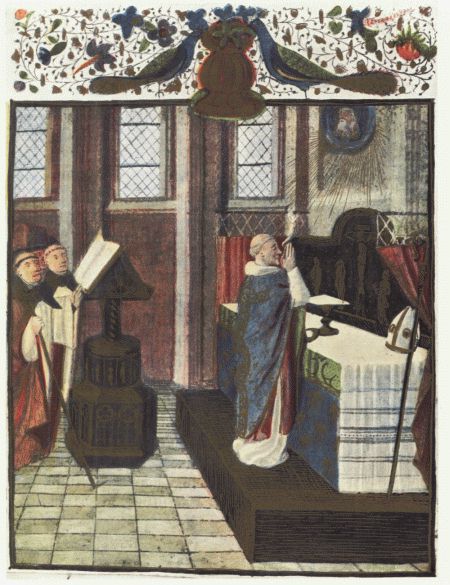
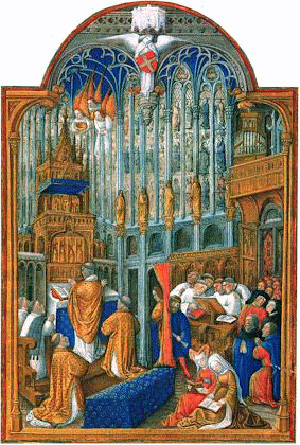

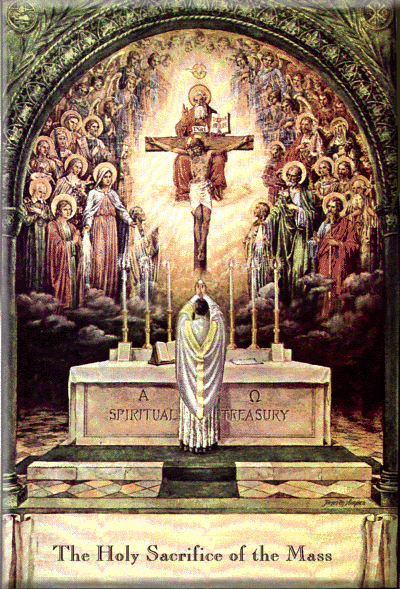


Hmmm. Res ipsa loquitur...
Wednesday, 26 February 2014
Reforming the Reform in three easy steps

1. Remove the elements of the New Mass that are not present in the Traditional Mass.
2. Reinstate the elements of the Traditional Mass that are not present in the New Mass.
3. Keep the elements of the New Mass that are present in the Traditional Mass.
Subscribe to:
Posts (Atom)