Showing posts with label prayer. Show all posts

Thursday, 30 November 2017

Christmas Anticipation Prayer

To be said fifteen times a day from St Andrew's feast day until Christmas Eve.


Saturday, 5 March 2016

St Philip Neri on prayer and charity

"To leave our prayer when we are called to do some act of charity for our neighbour, is not really a quitting of prayer, but leaving Christ for Christ, that is, depriving ourselves of spiritual sweetnesses in order to gain souls."

Monday, 30 November 2015

St Andrew Advent novena

It's that time again...

Hail and blessed be the hour and moment in which the Son of God was born of the most pure Virgin Mary, at midnight, in Bethlehem, in piercing cold. In that hour, vouchsafe, O my God! to hear my prayer and grant my desires, through the merits of Our Saviour Jesus Christ, and of His Blessed Mother. Amen.

To be said 15 times a day until Christmas.

Sunday, 30 November 2014

St Andrew Advent novena

Hail and blessed be the hour and moment in which the Son of God was born of the most pure Virgin Mary, at midnight, in Bethlehem, in piercing cold. In that hour, vouchsafe, O my God! to hear my prayer and grant my desires, through the merits of Our Saviour Jesus Christ, and of His Blessed Mother. Amen.

To be said 15 times a day until Christmas.

Wednesday, 26 November 2014

Prayer, Work, and Leisure - Cardinal Bacci

Prayer, Work, and Leisure
1. The pattern of our lives should be a combination of prayer, work, and leisure. There should be no room, however, for idleness.

“Prayer.” Prayer is most essential. The life of a Christian should be a continual prayer. As Jesus commanded, we “must always pray and not lose heart.” (Luke 18:1)

How can we achieve this? St. Paul has told us. “Whatever you d...o in word or in work,” he says, “do all in the name of the Lord Jesus, giving thanks to God the Father through him.” (Col. 3:17) If we follow his instructions, our lives will really be a prayer. Before we begin our day's work we shall turn to God and offer Him our labours and our difficulties. During our work we shall raise our minds to God from time to time as Jesus, Mary and Joseph must have done in the home and in the workshop at Nazareth. Whenever we speak, we should remember that we are in the presence of God. Then our conversation and our behaviour will be free from defect and will edify those who are with us. The grace of God can illumine the most ordinary conversations and actions which are in themselves quite indifferent. It is enough to live in a spiritual atmosphere of our own and to keep our thoughts turned towards God while we are living and walking on this earth. If we can aspire to such a spiritual height, then our work will become a prayer pleasing to God, whether it is mental or manual, pleasant or burdensome. God will grant us interior peace, moreover, for we shall be no longer working alone, but Jesus Christ will be working with us by His grace. This is the way the Saints worked, and this is how their lives were a prayer.

2. “Work.” Work is a duty commanded by God, Who after the sin of Adam told him and his descendants: “In the sweat of your brow you shall eat bread.” (Gen. 3:19) So work became an obligation and a means of expiation. We are all obliged, therefore, to engage in some kind of work, mental or manual, whether we are rich or poor. Idleness has been condemned by God as the father of all the vices. “Idleness,” warns the Holy Spirit, “is an apt teacher of mischief.” (Ecclus. 33:29) It is impossible for a man who works and prays to commit sin, both because he lacks the time and because he is close to God. A man who is close to God will certainly never offend Him, whereas the mind of a man who is lazy and inactive is open to the attractions of sin. Let us shun idleness, therefore, and love hard work as a means of making reparation for our sins and of gaining merit before God.

3. “Leisure.” Some of the Saints made it one of their resolutions to take about an hour's recreation every day. They were thinking in terms of rest, however, not of inactivity. Rest is the reward of labour and is necessary for frail human nature. Idleness, on the other hand, is a vice and the source of sin. We should take our repose only after our work and in consequence of it. Even during recreation we should continue to live in the presence of God and to think of Him from time to time. If we enjoy our leisure in the open air, everything speaks to us of God, for we are surrounded by the flowers and the birds. When St. Thérèse of the Child Jesus was going for a walk one day, she stopped to admire a tiny flower. Enraptured by its beauty, she exclaimed aloud: "How good you are, O God !" Our recreation can be the source of increased sanctification.

Monday, 27 October 2014

Hail Mary - Cardinal Bacci

Hail Mary

1. After the Lord’s Prayer there is no more beautiful prayer than the Hail Mary, which we should recite with particular devotion in the decades of the Holy Rosary. At the beginning of the Rosary we can imagine that we are witnesses of the Annunciation to Mary in her home at Nazareth. An Angel descends from Heaven and bows before the Blessed Virgin as she kneels absorbed in prayer. “Hail, full of grace,” he says, “the Lord is with thee. Blessed art thou among women.” (Luke 1:26-28) We should join with the Angel of God in repeating these words fervently and devoutly.

The constant repetition of this prayer is very pleasing to Mary, the Mother of God and our Mother. When we greet her with the words of the Angel, we remind her of the great mystery of the Incarnation, which was the beginning of her lofty mission as co-redemptrix and the dawn of Christian civilisation.

Even when we say these words over and over again, they can never become monotonous. When a son is speaking to his mother, every word possesses an unlimited warmth and meaning because it is the expression of a boundless love. When we recite the decades of the Rosary, we should think of the heavenly Mother who is watching over us and listening to us, eager to console and assist us. She loves us with a maternal love, but she requires us to love her also and to prove that we are her children by imitating her virtues.

2. The Angel’s greeting was later completed by the salvation of St. Elizabeth. As soon as Elizabeth saw the Blessed Virgin coming to visit her, she cried out in humble veneration: “Blessed art thou among women and blessed is the fruit of thy womb!” (Luke 1:42)

In the first part of the Hail Mary, then, we pay her in the words of the Gospel the highest tributes ever accorded to any human creature, proclaiming her to be full of grace, blessed among women, and Mother of the Redeemer. The second part, which was later added by the Church, is a heartfelt supplication addressed to Mary as the Mother of God and our Mother. “Holy Mary, Mother of God, pray for us sinners, now and at the hour of our death. Amen.” It would be hard to find a more touching plea. We ask our heavenly Mother to intercede for us now because we have such great need of her assistance in this vale of tears and temptations. May she be always by our side to shelter us beneath her mantle.

3. We seek her intercession, moreover, at the hour of death. Death must come, but if we have prayed often to our heavenly Mother she will certainly be with us in those final and decisive moments of our lives. If Mary is there to help us, we may be sure that death will come as a consolation, for it will be a peaceful journey towards everlasting happiness.

“Deliver Us From Evil” - Cardinal Bacci

“Deliver Us From Evil”

1. “Deliver us from evil. Amen.” This is our last request in the Lord’s Prayer. God is our Father, Creator, and Redeemer, Who cannot desire our ruin, but only our welfare. Nevertheless, He wishes us to ask Him every day to deliver us from evil.

We ask God to deliver us from evil of any kind. There is nothing to prevent us from beseeching Him to save us from physical ills, such as sickness or hardship or any of the other many afflictions of life. God loves us and therefore does not wish us to have to suffer. He loves us, however, as He knows best, and so desires our true welfare. He knows that suffering and sorrow are our necessary heritage in life. They are the salt which preserves us from corruption.

It would be fatal for us to be always happy in this world, for then we should forget God and our true everlasting happiness. By all means let us ask humbly for deliverance from bodily ills, but let us not complain if God does not grant our request. He alone knows what is best for us now and in the future.

Finally, when we ask God to rescue us from material evils, we should do so in a spirit of submission and resignation to His holy will. “Thy will be done on earth as it is in Heaven.” We should keep in mind the words of Jesus Christ. “If anyone wishes to come after me, let him deny himself, and take up his cross daily, and follow me.” (Luke 9:23) Where are we to follow Him? To Calvary, of course. We must suffer and die as He did. Only afterwards can we achieve everlasting happiness.

Deliver us from evil, therefore, O God. Deliver us if possible from bodily and from earthly ills, but let Your will be done. We realise that there is a purpose in suffering, the mission of which is to purify us and lead us more easily to You. We shall thank You if You hear our plea, but we shall be no less grateful if it pleases You to reject it.

2. When we ask God to deliver us from evil, we should think chiefly of the real evil, which is spiritual. All other evils are insignificant in comparison with sin, which is an offense committed against God , our only good. Sin robs us of His grace, which is the supernatural life of the soul, deprives us of His friendship, and is an act of ingratitude towards our supreme Benefactor.

When we pray to God to deliver us from evil, we should renew our determination to avoid sin by every means in our power. Prayer is futile unless it is accompanied by the resolution never to offend God again. Our prayers and good resolutions will draw God’s favour and will strengthen our bond of intimacy with Him.

3. Deliver us, O God, from the evil of the eternal damnation. Sin is the greatest evil, but as long as we are on earth it is an evil which can still be remedied, for God in His infinite mercy is always ready to forgive us and to restore us to His divine friendship if we sincerely repent. In Hell, however, there is no further remedy, for there the mercy of God has been superseded by His infinite justice. Where the tree falls, there it must lie forever. Such dreadful unhappiness is barely conceivable.

Deliver us from sin, O God; deliver us from a bad death; deliver us from Hell. Help us to love You more and more and to serve You more faithfully so that we may one day enjoy Your blessed company for all eternity. Amen.

“Lead Us Not Into Temptation” - Cardinal Bacci

“Lead Us Not Into Temptation”

1. “Let no man say when he is tempted,” St. James warns us, “that he is tempted by God; for God is no tempter to evil, and he himself tempts no one. But everyone is tempted by being drawn away and enticed by his own passion. Then when passion has conceived, it brings forth sin, but when sin has matured, it begets death.” (James 1:13-15)

When we ask God during the Pater Noster not to lead us into temptation, we should really beseech Him to rescue us from temptation. We should not request this in any absolute sense, however, for it would be a poor soldier who would refuse to be tried in battle. Our prayer should be prompted by a holy fear of offending God. We should ask Him, therefore, either to set us free from temptations or to grant us the grace to overcome them. We should then co-operate earnestly with divine grace in resisting these temptations and should adopt the means necessary to overcome them.

In the first place, we should never go voluntarily into an occasion of sin. What use is it asking God to rescue us from temptations if we immediately proceed to go in search of them? When possible, therefore, avoid the occasions of sin. “He who loves danger,” says the Holy Spirit, “will perish in it.” (Ecclus. 3:25) If duty or charity compels us to expose ourselves to danger, God will certainly help us. But if we fail to recognise our own frailty and expose ourselves voluntarily to the risk of committing sin, God is not obliged to work a miracle to save us. Our presumption and imprudence will be severely punished.

2. Life is a prolonged trial. St. Paul compares it to a stadium in which everyone must fight to win. If anyone lays down his arms, he will be unable to conquer his passions or to achieve the palm of victory. “One who enters a contest is not crowned unless he has competed according to the rules.” (2 Tim. 2:5)

With the exception of the Blessed Virgin, every human being is obliged to battle against the temptations of the flesh. Sometimes these can be quite terrifying. St. Paul himself confessed that he felt another law in his members warring against the law of his mind. “Unhappy man that I am!” he exclaimed in supplication to God to come to his assistance. “Who will deliver me from the body of this death?” (Rom. 7:24)

The false enchantment and wickedness of the world also threatens to ensnare us. “We know that we are of God, and the whole world is in the power of the evil one.” (1 John 5:19) It is easy to become absorbed in worldly affairs and to forget the all-important spiritual realities.

Finally, there is the devil, whom St. Peter describes as wandering about “seeking someone to devour. Resist him,” he urges us, “steadfast in the faith, knowing that the same suffering befalls your brethren all over the world.” (Cf. 1 Peter 5:9)

Faced as we are with these three foes, we should implore God to help us by His grace. Lead us not into temptation, O God, but help us to conquer these enemies. Without You we can do nothing, but with Your aid anything is possible. Lead us not into temptation.

3. Why, we may ask, does God permit us to be tempted? It is for our own good, because (1) He desires us to co-operate with Him in our own salvation. The crown of glory which is to be our reward will only be given to him who has earned it. “Blessed is the man who endures temptation,” says St. James, “for when he has been tried, he will receive the crown of life which God has promised to those who love Him.” (James 1:12) (2) He wishes us to understand, moreover, that we can do nothing without Him, so that we may be humble and may pray to Him with faith and perseverance. (3) He desires that we may be vigilant and may live in union with Him by means of prayer. He wishes us to realise that only with His help can we aspire to the supernatural life and triumph over our enemies. Apart from Him we shall be lost, but close to Him we shall be invincible.

“As We Also Forgive Our Debtors” - Cardinal Bacci

“As We Also Forgive Our Debtors”

1. When we ask God to forgive us, we promise to forgive those who have offended us. Unless we are to be guilty of deception, therefore, we must pardon them. If we refuse to forgive, God will not forgive us. Jesus tells us in the Gospel to pardon offences not seven times, but seventy times seven. (Cf. Mt. 18:22) In other words, we must always be prepared to forgive. He tells us to return good for evil and to turn the other cheek when someone strikes us.

Not alone did Jesus command us to do this, but He also set us an example. While He was suffering fearful torments on the Cross and was surrounded by jeering enemies, He turned to His heavenly Father and uttered those sublime words: “Father, forgive them, for they do not know what they are doing.” (Luke 23:24)

How could we gaze at the Crucifix and dare to refuse forgiveness to anyone? No matter how grave may seem the injuries done to us by our neighbour, let us remember that they are insignificant in comparison with the insults which we have dared to offer to the infinite majesty of our Creator. They are as the hundred denarii compared with the ten thousand talents of Christ’s parable. (Mt. 18:24-28)

If we wish to receive God’s pardon, therefore, let us be prepared to forgive. Let our forgiveness be sincere, however, and not a mere formal token. The forgiveness freely granted by a heart scourged by the injuries of others is a pleasing sacrifice offered to God.

2. “If thou art offering thy gift at the altar,” Jesus tells us, “and thou rememberest that thy brother has anything against thee, leave thy gift before the altar and go first to be reconciled to thy brother, and then come and offer thy gift.” (Mt. 5:23-24) Prayer is futile, therefore, unless we have first forgiven our enemies.

“Learn from me,” Jesus said when He proposed Himself as a model to be imitated, “for I am meek and humble of heart.” Then, He added, “you will find rest for your souls.” (Cf. Mt. 11:29) How true this is. The foundation of our hatred, anger, and resentment is always our wounded pride. We need Christlike gentleness and humility if we are to forgive sincerely and generously. Only when we have this gentleness and humility, moreover, shall we find joy in forgiving, and only then shall we have peace. As long as there is room in our hearts for pride and hatred, we can never enjoy peace of soul.

3. Some people hold that it is base and low-spirited to forgive easily, whereas a keen sense of honour demands revenge. Nothing could be more false. Even animals seek revenge. The true greatness of human nature lies in its ability to conquer the lower instincts. “It is far more difficult,” wrote a famous historian of antiquity, “to overcome oneself than to defeat one’s enemy in battle.” (Val. Max., L, 4) Forgiveness requires a victory over pride and sensitivity and is therefore a high act of human value.

When we forgive, we do not abase ourselves before the man who has offended us, but we raise ourselves above him by our nobility and generosity. By behaving in this manner we display our self-control, inspire sentiments of respect and benevolence, and may even bring about a reconciliation and a renewal of friendship.

So let us make a few good resolutions. (1) Remembering how Jesus prayed for His executioners, let us always be generous in pardoning others. (2) Let us do good to those who have offended us, adopting the motto of St. Paul: “Be not overcome by evil, but overcome evil with good.” (Rom. 12:21) (3) When the injury which we have received disturbs us greatly and causes us to lose our peace of mind, let us remain silent and procrastinate. “Delay is the best cure for anger,” wrote Seneca, who also very truly observed that whenever we have been angry with others we end by being angry with ourselves.

“Forgive Us Our Debts” - Cardinal Bacci

“Forgive Us Our Debts”

1. When we have asked God for nourishment for soul and body, we go on to implore forgiveness for our debts, whether they have been contracted in the course of nature, or of grace, or of sin. We owe everything to God. There was a time when we did not exist, and in His divine omnipotence He created us from nothing. Our bodily powers and spiritual faculties are His gifts to us. If we enjoy health, it is He Who has given it to us. If we have any ability, it comes from Him. Anything which we have been able to achieve as the result of mental or manual labour has been made possible by His help.

Who is it but God Who rescues us from the many perils which surround us? Who but He enables us to overcome so many difficulties? How many times we should have died if He had not sustained us!

Let us think back over our past lives. How much reason we have to be grateful to God, Who has watched over us continually like a loving Father. The conservation of life is a continuous act of creation. When we recite the Pater Noster, therefore, we should express our filial gratitude to God and ask for His continued protection. Every moment of life is a new gift of God and an act of His infinite love in our regard. Let us be grateful and love Him generously in return.

2. Over and above these natural debts, we are also indebted to God for His grace. Not only has God created us, but He has also raised us to the supernatural order. By His grace He has made us His friends and His adopted children. As a result of original sin we lost this supernatural life and were unable to regain it by our own efforts.

God was moved with compassion for us, however, and sent His own divine Son to sacrifice Himself for love of us in order to redeem us and to restore to us the supernatural life of the soul. We are greatly indebted in the supernatural order, therefore, to our Creator and our Redeemer. The only way in which we can adequately satisfy our obligation is by offering up the infinite merits of Jesus Christ.

We have been born, moreover, in the Catholic Church and have received a Christian education. God has always been close to us with His Sacraments. By means of Baptism He caused us to be born again to a life of grace. Whenever we fell, He raised us up again through the Sacrament of Penance, and when we were weak and faltering He nourished us with His Eucharistic food. Let us adore Him and acknowledge that we can never thank Him enough for all that He has done for us. That is why we need to repeat time and time again: Forgive us our debts.

3. Finally, we owe God a great deal on account of our sins. Unfortunately, our only return for God’s continual favours has been negligence, ingratitude, and sin. How many failings we have been guilty of throughout our lives. Since it is an offence against God, Who is infinitely good and amiable, even venial sin cannot properly be atoned for by the merits of all the Angels and of all the Saints of Heaven. Therefore it was necessary for the Son of God made man to offer Himself as a victim of expiation on our behalf.

Remembering His infinite merits, we should humbly ask God: Forgive us our debts, that is, our many sins and failings and whatever punishment is owing to us, for every sin demands some expiation either in this life or in the next. Meanwhile, we should accept with resignation all the sufferings which God sends us in reparation for our sins, and we should promise never to offend Him any more.

Our Daily Bread - Cardinal Bacci

Our Daily Bread

1. In the Pater Noster Jesus instructs us to ask for our daily bread – that is, for sufficient bread for today, not for tomorrow. In this way He warns us not to be too preoccupied with the future, but to trust in Providence and accept from God’s hands from day to day whatever is necessary for us. God is our Father and loves us as His children. Knowing this, why should we worry about the future?

We are in the hands of God, Who looks after all His children. Let us entrust ourselves completely to His care. This does not mean that we should indulge in any kind of fatalism, expecting everything from God and doing nothing ourselves. We cannot and should not expect unnecessary miracles. We are under an obligation to work, because work is the result of, and the punishment for, sin. It enables us to co-operate with God in His work of creation and has been ennobled and sanctified by Jesus Christ, Who chose to be “the carpenter’s son,” (Mt. 13:55) and a carpenter Himself. (Cf. Mk. 6:3) We should work, therefore, but should not worry.

When we have done everything of which we are capable, we should leave the rest to Divine Providence.

We should not desire, moreover, to accumulate riches which, as the Gospel warns us, often turn out to be thorns which choke us (Cf. Luke 8:14) and halt our progress towards God. We should desire instead the true spiritual riches, namely, divine grace and virtue. We should be prepared to expend all our energy in order to acquire these. If material wealth comes our way, however, it is not necessary to reject it. Evangelical poverty is not a command, but simply a counsel of perfection. As long as we use it well and do not become too attached to it, wealth can be an instrument of virtue and powerful means of doing good. (Cf. St. Thomas, Contra Gentiles, III, 134)

2. We can find this teaching which is contained in these words of the “Our Father” in another section of the Gospel, where Jesus tells us not to ask for riches and not to hoard goods for the future, but to pray and work from day to day for our daily needs. “Do not be anxious for your life, what you shall eat, nor yet for your body, what you shall put on… Look at the birds of the air; they do not sow, or reap, or gather into barns; yet your heavenly Father feeds them… Consider how the lilies of the fields grow; they neither toil nor spin, yet I say to you that not even Solomon in all his glory was arrayed like one of these. But if God so clothes the grass of the field, which flourishes today but tomorrow is thrown in the oven, how much more you, O you… you of little faith! … Therefore do not be anxious about tomorrow; for tomorrow will have anxieties of its own. Sufficient for the day is its own trouble.” (Cf. Mt. 6:25-34)

3. When we pray to God to give us our daily bread, we should remember this beautiful sermon of Christ, which will remove all our anxiety and worldly worry. As long as we are prepared to do our work, we shall obtain our daily bread from our loving Father and shall receive in addition spiritual peace, confidence, and perfect resignation to His holy will.

“Give Us This Day Our Daily Bread” - Cardinal Bacci

“Give Us This Day Our Daily Bread”

1. In the second part of the Lord’s Prayer we ask the universal Father, on behalf of ourselves and of our brethren, for all things necessary for soul and body. Since we have already paid homage to God, our Creator and our Redeemer, and have prayed for the triumph of His kingdom and for the accomplishment of His will in Heaven and on earth, Our Lord does not forbid us to think now of ourselves and to pray for our own needs. “Give us this day our daily bread,” we ask, intending to pray both for our spiritual and material requirements.

We should not delude ourselves into imagining that it is we who produce the fruits of the earth. A grain of wheat dies beneath the soil, but God has infused into it a mysterious force as a result of which, in dying, it generates new life.

The moisture of the soil, the warmth of the air, and the light of the sun combine to develop this mysterious life-force, which produces the green stalk and then the flaxen ear of corn which provides us with bread. It is God Who has given this vital power to this tiny seed, as well as to all the other seeds of the soil. It is He Who has endowed the soil with the nutritive elements from which the seeds draw life, and it is He Who sends the dew, the rain, and the sunshine, which cause the flowers to blossom and the plants to bear fruit.

We should ask God humbly, therefore, to “give us this day our daily bread.” Our own labours would be futile without the intervention of the all-powerful Creator. We are capable neither of producing nor of destroying a single atom nor a single seedling. Without God we are incapable of achieving anything either in the natural or in the supernatural order. Therefore we must ask Him to provide us with what we need. He is supremely good and loves us very much. His Providence will not leave us in want, even if we are often obliged to work hard in co-operation with Him to procure the necessaries of life. The birds have no granary, yet they manage to find enough seed to keep them alive because God is watching over them. How could we suppose that He will not look after us if we turn to Him with trust and perseverance?

2. Note that each one of us prays for “our daily bread,” not for “my daily bread.” We should not ask only for our own requirements, but for those of all our fellow-men as well.

There are many poverty-stricken people for whom bread is very scarce. We should pray especially for them and should be prepared to share our bread with those who have none. Both charity and justice demand this of us. Let us ask, moreover, only for our necessary requirements, not for wealth and luxury. Anything superfluous which we possess does not belong to us, but to the poor. “Give that which remains,” the Gospel commands, “as alms.” (Luke 11:41) Let us remember that, whether we are rich or poor, we are all one great family. Our love for one another should not be merely theoretical, but practical; otherwise we are not sincere Christians.

3. We should not ask only for food for the body, but for spiritual nourishment. “Not by bread alone does man live,” says Holy Scripture, “but by every word that comes forth from the mouth of God.” (Mt. 4:4; cf. Deut. 8:3) The soul must be nourished as well as the body, for it has its own life which is worn away by the daily conflict against sinful inclinations and by the constant struggle to achieve sanctity. It needs to be nourished by the word of God, by His grace, and especially by receiving the Author of grace frequently in Holy Communion. We should ask before anything else for the grace of God and for the true bread of life which descends from Heaven. “Whoever eats this bread will live forever.” Let us ask for this life-giving bread for ourselves and for our unfortunate brothers who are living apart from Jesus in a state of spiritual death. May daily Communion become once more the inexhaustible source of the spiritual life and of Christian virtue which it was in the early days of the Church.

The First Part of the “Our Father” - Cardinal Bacci

The First Part of the “Our Father”

1.The Pater Noster, being God’s own composition, is the most perfect of prayers. It covers, moreover, all our obligations and all our needs. It may be divided into two parts, the first of which refers to God, the second to ourselves. We should ask first of all for whatever is important to God, and then for whatever concerns ourselves. This is the command of Jesus. “Seek first the kingdom of God and His justice, and all these things shall be given you besides. (Mt. 6:33)

When we have invoked our Father in Heaven we go on to pray: “Hallowed be Thy name.”

Let us think about this. What do we look for first of all when we pray? Is it the glory of God, or is it our own self-interest? Which occupies the principal place in our thoughts, God or our own ego? Let us remember that we have been created for the glory of God. We shall not find happiness unless we seek God’s glory alone, for God is our true welfare.

We must not allow ourselves to become absorbed in insignificant worldly objects, which can never completely satisfy us. Rather must we keep our minds on God. “God alone is sufficient,” said St. Teresa. Without Him there is nothing good within us or around us.

When we say “Hallowed be Thy name,” moreover, we should not only give God’s glory precedence over all our desires, but we should also make an act of reparation for the countless blasphemies by which His name has been injured. How can we remain passive and inert while our Creator and our Redeemer is being continually blasphemed and offended? At the very least we can set against the diabolical insults of many of our fellow-men our own humble and loving prayer: “May Thy name, my God, be blessed and glorified.”

2. Our second ejaculation is: “Thy kingdom come.” It is true that God reigns over Heaven, earth, and the infernal regions. Everything is subject to His will; the sun, the stars, the birds of the air, the fishes of the sea, and the tiniest insects carry out His commands. Even the demons of Hell, who He has condemned to eternal punishment, are obedient to His will. But what about the human race?

Man possesses the precious but dangerous privilege of free will, which he has power to abuse by rebelling against God. We should pray that the sovereignty of God many be triumphant in all hearts, beginning with our own, and that all men may willingly subject themselves to His commandments and to His grace. This is the only way in which they can find peace. “Take my yoke upon you... and you will find rest for your souls.” (Mt. 11:29)

We should pray, moreover, for the Church, which is the kingdom of God on earth. We should pray for her peaceful victory over her enemies, who persecute her and impede her work for the salvation of souls. We should love the Church even as we love Jesus Christ, for the Church is His handiwork and the fruit of His Precious Blood.

3. “Thy will be done on earth, as it is in Heaven.” There is infinite and everlasting happiness in Heaven because all the blessed do God’s will in a spirit of love and find perfect peace in Him.

We have a strict obligation to do God’s will, because we all owe prompt and generous obedience to our Creator and Redeemer. Furthermore, this is the only way in which we can acquire peace of soul, which is the beginning of true happiness. “There is no peace to the wicked.” (Is. 48:22) The sinner can never be at peace.

Therefore, when we say “Thy will be done on earth, as it is in Heaven,” let us resolve to do God’s will in all things in the manner of the blessed in Heaven. Our reward will be spiritual peace, even in the midst of trial and sorrow.

The “Our Father” - Cardinal Bacci

The “Our Father”

1. Our Lord exhorted His disciples on many occasions to pray often and with confidence if they wished to be heard. Everything which they asked His heavenly Father in His name, He said, they would obtain. Ask, He said, and it shall be given you; seek, and you shall find, knock, and it shall be opened to you. Finally, He insisted that we ought to pray and never to give up. In other words, life can be a continuous prayer if we offer to God all our thoughts, words, and actions.

The ideal Christian prayer is to do the will of God at all times from the motive of pure love. The Apostles, however, who had not made that much progress in the spiritual life, asked Jesus to teach them how to pray. (Luke 11:1) It was then that Our Lord composed the most beautiful of prayers, the “Our Father.” (Mt. 6:9-13) When we recite it, we speak to God in the words of Jesus Christ Himself and unite our weak voices with the powerful voice of the Son of God. We address the Eternal God, moreover, by the name of Father. Even in the Old Testament God is often referred to in this way. Then, however, He figured as the Father of the chosen people, whereas now He is the Father of all. He is our Father, the Father of all mankind and of all races, whom He has willed to redeem from the slavery of sin. The term “Our Father” has taken on a new and fuller meaning. Our weak prayer becomes united to that of Jesus, our first-born brother, and to the prayers of the Apostles, Martyrs, Virgins, and Confessors, who form and have formed throughout the centuries the Mystical Body of Christ which is the Church. We need no longer feel that we are on our own, for through the Communion of Saints our entreaties are joined to those of the entire Church, militant, suffering, and triumphant. We can be confident, therefore, that our prayer will be heard.

2. “Our Father, Who art in Heaven.” Heaven is God Himself, Who reveals Himself to the souls of the blessed. If a man lives in God, his mind and heart are already in Heaven, even though he is still an exile upon this earth. It is a wonderful experience to lead a bodily existence upon earth while our minds are with God in heaven, for, as St. Paul says, “our citizenship is in heaven.” (Phil. 3:20) As we are aware, God is everywhere, in Heaven and on earth. When we invoke our Father Who is in Heaven, however, we manifest our faith in Him and in His generosity, whereby He reveals Himself in all His glory to the blessed and shows His mercy to us poor exiles when we come to Him. In the first words of the Pater Noster, we express not only our faith, but also our hope of being happy with God for all eternity.

3. God is truly our Father because He created us from nothing and because He caused us to be born again through the Incarnation of His only-begotten Son and the work of the Redemption. In this way He is doubly our Father.

Can we claim, however, to be true sons of God? It is not enough simply to make this claim by reciting the “Our Father,” but we should prove it in a practical way in our daily lives. We can do this by accepting God’s will in all things, by obeying His commandments and the precepts of the church, and especially by loving Him more than anything in creation.

Wednesday, 30 July 2014

The Main Way to Conquer Temptation - Cardinal Bacci

The Main Way to Conquer Temptation

1. God never allows us to be tempted beyond our strength, but will always give us the grace which we need in order to resist. “God is faithful,” St. Paul writes, “and will not permit you to be tempted beyond your strength, but with the temptation will always give you a way out that you may be able to bear it.” (Cor. 10:13)

The man who is so discouraged by frequent falls that he surrenders to temptation and resigns himself to the slavery of sin as if there were no other way out, is making a fatal mistake. God is infinitely good and merciful and loves us all, even those who are sinners. Remember the parable of the Prodigal Son and of the lost sheep. How could our heavenly Father abandon us and not give us the strength to resist evil?

If we are discouraged, let us ask God's help, for He loves us and knows how weak we are. “He knows how we are formed.” (Ps. 102:14) It is a favourite trick of the devil to persuade us that nothing can help us. Let us cast aside all thoughts of discouragement, therefore, and arm ourselves with the necessary spiritual weapons. With humility, perseverance, and the grace of God, we are sure to triumph.

2. The masters of the spiritual life suggest various ways of combating temptation. As St. Alphonsus de' Liguori points out, however, “the first way is absolutely essential, and that is to pray to God for the light and strength to conquer. Without prayer it is impossible to overcome temptation, whereas with prayer we are sure of victory.” (Al Servizio Divino, p. 11, c. 6)

The reason is obvious. Prayer is not simply a verbal address to Almighty God, but is an elevation of the mind and heart, a conversation with God. Let us pray, therefore, with confidence and with love.

3. Jesus Himself commands us to do this. “Watch and pray that you may not enter into temptation.” (Mt. 26:41) Temptation against chastity in particular can only be conquered by prayer. There must be no hesitation, but an immediate recourse to God as soon as the temptation is experienced.

“Slay the enemy while it is small,”' recommends St. Jerome. When a lion is small, it is easily killed, but if we wait for it to grow up, it will be more likely to kill us instead. It is the same with temptation. St. Francis de Sales tells us that we should imitate the little children who fly to the arms of their father and mother as soon as they spy a wolf. We should fly to Jesus and Mary for protection.

As long as temptation lasts we should persevere in prayer.

Monday, 7 July 2014

The Gift of Speech - Cardinal Bacci

The Gift of Speech

1. One of God's greatest gifts, the spoken word, is the reflection of our thought and the expression of our will. In God the Word is something infinitely greater, for it is the substantial image of God, the Eternal Word of the Father through Whom He knows and therefore loves Himself. It is the Second Person of the Blessed Trinity. Because we have been created in the likeness of God, our Creator has endowed us also with a limited power to express our thoughts and sentiments.

It is hard to imagine how unhappy we should be if we could not express ourselves and were unable to communicate our ideas and feelings to others. We should feel as isolated as rocks separated from one another by vast expanses of sea, for we could neither give anything of ourselves to other men nor receive anything in return. We could not even praise God and tell Him how we love Him. God could have created us without the gift of speech. Since He has given it to us, we should show our gratitude by using it for His glory, for our welfare, and for the salvation of our neighbour.

2. Above all, the gift of speech is intended to be used in prayer. The tongue should express externally the interior language of the mind and heart, which should be principally concerned with the adoration of our Creator. Since we have received everything which we have from God, all our gifts should be used in His service. Speech was given to us not only to enable us to speak with men, but more particularly to enable us to speak with God. Let us sanctify this gift by means of prayer. Let us take care, however, that our prayers do not remain meaningless and superficial while our minds are absorbed with other matters.

Everything in us should pray. The intellect should bow in adoration of God's majesty; the will should conform itself entirely to His law; the heart should find its true and only happiness in God; and the tongue should praise Him, implore His favour and forgiveness, and offer our whole being to Him from Whom we have received everything. This should be the primary function of speech. If this gift is employed in this way, it will gain for us many other graces and favours from God.

3. Speech was never intended to be used in lying and in deceiving our neighbour, nor in giving scandal by unkind or blasphemous conversation. It was given to us so that we might help others by conversation which would reflect our own interior goodness and so lead them towards sanctity. It was intended to express sympathy and understanding, to give good advice, and to encourage others.

The tongue can do a great deal of good or a great deal of damage.

Let us examine our consciences now. If we have failed to employ the gift of speech for our own welfare and that of our neighbour, let us begin to correct this neglect. Let us resolve to use this gift in the service of God and in the work of the Christian Apostolate.

Tuesday, 1 July 2014

Litany of the Most Precious Blood


Litany of the Most Precious Blood

Lord, have mercy.
Christ, have mercy.
Lord, have mercy.

Jesus, hear us. Jesus, graciously hear us.

God, the Father of Heaven, Have mercy on us.
God, the Son, Redeemer of the world,
God, the Holy Spirit,
Holy Trinity, One God,

Blood of Christ, only-begotten Son of the Eternal Father, Save us.
Blood of Christ, Incarnate Word of God,
Blood of Christ, of the New and Eternal Testament,
Blood of Christ, falling upon the earth in the Agony,
Blood of Christ, shed profusely in the Scourging,
Blood of Christ, flowing forth in the Crowning with Thorns,
Blood of Christ, poured out on the Cross,
Blood of Christ, price of our salvation,
Blood of Christ, without which there is no forgiveness.
Blood of Christ, Eucharistic drink and refreshment of souls,
Blood of Christ, stream of mercy,
Blood of Christ, victor over demons,
Blood of Christ, courage of Martyrs,
Blood of Christ, strength of Confessors,
Blood of Christ, bringing forth Virgins,
Blood of Christ, help of those in peril,
Blood of Christ, relief of the burdened,
Blood of Christ, solace in sorrow,
Blood of Christ, hope of the penitent,
Blood of Christ, consolation of the dying,
Blood of Christ, peace and tenderness of hearts,
Blood of Christ, pledge of eternal life,
Blood of Christ, freeing souls from purgatory,
Blood of Christ, most worthy of all glory and honor,

Lamb of God, who take away the sins of the world. Spare us, O Lord.
Lamb of God, who take away the sins of the world, Graciously hear us, O Lord.
Lamb of God, who take away the sins of the world, have mercy on us.

You have redeemed us, O Lord, in your Blood. And made us, for our God, a kingdom.

Let us pray, ---  Almighty and eternal God, you have appointed your only-begotten Son the Redeemer of the world, and willed to be appeased by his Blood. Grant we beg of you, that we may worthily adore this price of our salvation, and through its power be safeguarded from the evils of the present life, so that we may rejoice in its fruits forever in heaven. Through the same Christ our Lord.
Amen.

Friday, 27 June 2014

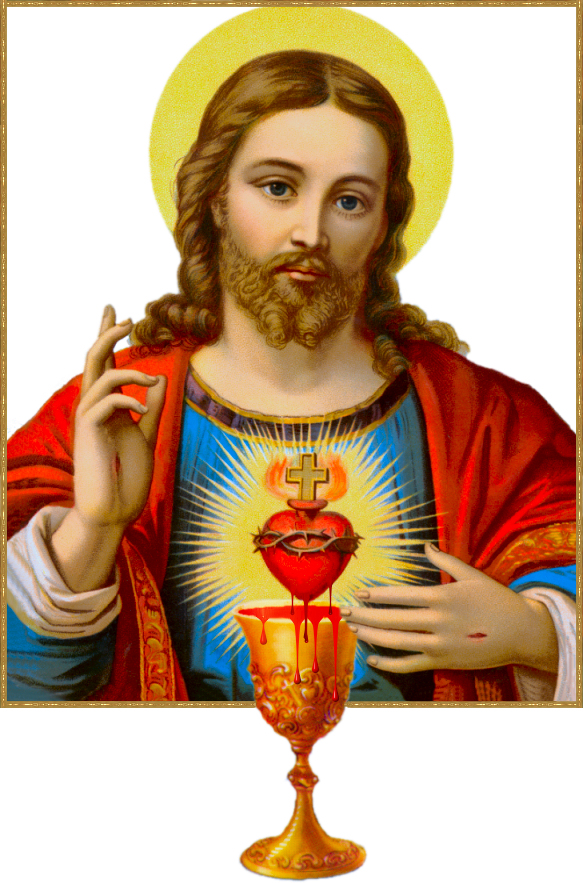
Feast of the Sacred Heart


Litany of the Sacred Heart


Lord, have mercy
Christ, have mercy
Lord, have mercy

Christ, hear us
Christ, graciously hear us.

God the Father of Heaven, have mercy on us
God the Son, Redeemer of the world,
God, the Holy Spirit,
Holy Trinity, One God,
Heart of Jesus, Son of the Eternal Father,
Heart of Jesus, formed by the Holy Spirit in the womb of the Virgin Mother,
Heart of Jesus, substantially united to the Word of God,
Heart of Jesus, of Infinite Majesty,
Heart of Jesus, Sacred Temple of God,
Heart of Jesus, Tabernacle of the Most High,
Heart of Jesus, House of God and Gate of Heaven,
Heart of Jesus, burning furnace of charity,
Heart of Jesus, abode of justice and love,
Heart of Jesus, full of goodness and love,
Heart of Jesus, abyss of all virtues,
Heart of Jesus, most worthy of all praise,
Heart of Jesus, king and center of all hearts,
Heart of Jesus, in whom are all treasures of wisdom and knowledge,
Heart of Jesus, in whom dwells the fullness of divinity,
Heart of Jesus, in whom the Father was well pleased,
Heart of Jesus, of whose fullness we have all received,
Heart of Jesus, desire of the everlasting hills,
Heart of Jesus, patient and most merciful,
Heart of Jesus, enriching all who invoke Thee,
Heart of Jesus, fountain of life and holiness,
Heart of Jesus, propitiation for our sins,
Heart of Jesus, loaded down with opprobrium,
Heart of Jesus, bruised for our offenses,
Heart of Jesus, obedient to death,
Heart of Jesus, pierced with a lance,
Heart of Jesus, source of all consolation,
Heart of Jesus, our life and resurrection,
Heart of Jesus, our peace and our reconciliation,
Heart of Jesus, victim for our sins
Heart of Jesus, salvation of those who trust in Thee,
Heart of Jesus, hope of those who die in Thee,
Heart of Jesus, delight of all the Saints,

Lamb of God, who taketh away the sins of the world, spare us, O Lord.

Lamb of God, who taketh away the sins of the world, graciously hear us, O Lord.

Lamb of God, who taketh away the sins of the world, have mercy on us, O Lord.


V. Jesus, meek and humble of heart.

R. Make our hearts like to Thine.

Let us pray;

Almighty and eternal God, look upon the Heart of Thy most beloved Son and upon the praises and satisfaction which He offers Thee in the name of sinners; and to those who implore Thy mercy, in Thy great goodness, grant forgiveness in the name of the same Jesus Christ, Thy Son, who livest and reignest with Thee forever and ever. Amen.

Friday, 13 June 2014

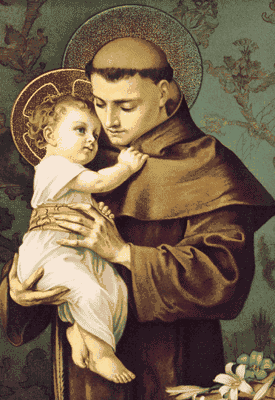
St Anthony of Padua


Litany of Saint Anthony of Padua 
(For Private Use)

Lord, have mercy on us.
Christ, have mercy on us.
Lord, have mercy on us.
Christ, hear us.
Christ, graciously hear us.
God, the Father of Heaven, have mercy on us.
God, the Son, Redeemer of the world, have mercy on us.
God, the Holy Spirit, have mercy on us.
Holy Trinity, one God, have mercy on us.

Holy Mary, pray for us.
Saint Anthony of Padua,
Saint Anthony, glory of the Friars Minor,
Saint Anthony, ark of the testament,
Saint Anthony, sanctuary of heavenly wisdom,
Saint Anthony, destroyer of worldly vanity,
Saint Anthony, conqueror of impurity,
Saint Anthony, example of humility,
Saint Anthony, lover of the Cross,
Saint Anthony, martyr of desire,
Saint Anthony, generator of charity,
Saint Anthony, zealous for justice,
Saint Anthony, terror of infidels,
Saint Anthony, model of perfection,
Saint Anthony, consoler of the afflicted,
Saint Anthony, restorer of lost things,
Saint Anthony, defender of innocence,
Saint Anthony, liberator of prisoners,
Saint Anthony, guide of pilgrims,
Saint Anthony, restorer of health.
Saint Anthony, performer of miracles,
Saint Anthony, restorer of speech to the mute,
Saint Anthony, restorer of hearing to the deaf,
Saint Anthony, restorer of sight to the blind,
Saint Anthony, disperser of devils,
Saint Anthony, reviver of the dead.
Saint Anthony, tamer of tyrants,

From the snares of the devil, Saint Anthony deliver us.
From thunder, lightning and storms,
From all evil of body and soul,
Through your intercession, Saint Anthony protect us.
Throughout the course of life,

Lamb of God, who takes away the sins of the world, spare us, O Lord.
Lamb of God, who takes away the sins of the world, graciously hear us, O Lord.
Lamb of God, who takes away the sins of the world, have mercy on us.

V. Saint Anthony, pray for us.
R. That we may be made worthy of the promises of Christ.

O my God, may the pious commemoration of Saint Anthony, your Confessor and Proctor, give joy to your Church, that she may ever be strengthened with your spiritual assistance and merit to attain everlasting joy. Through Christ our Lord. Amen.