The Fourth Glorious Mystery
The Assumption of the Blessed Virgin into Heaven
1. The Fourth Book of Kings tells us that the prophet Elias was brought
up into Heaven in a fiery chariot without having first endured the
pains and humiliation of death. (Cf. 4 Kings 2:11) Why did God not do
likewise in the case of the Blessed Virgin, commanding His Angels to
bear her to Heaven before death struck
her innocent body? As St. Paul says, it was sin which caused death to
enter the world. From the moment of her conception Mary was free from
the slightest taint of sin, for she was immaculate and full of grace.
Nevertheless, according to the most widely held tradition, Mary chose to
die even as her divine Son had willed to die. Jesus “was offered
because it was his own will.” (Is. 53:7) The same is true in Mary’s
case, with only this difference. Jesus died a cruel death after the most
hideous tortures in the midst of a blaspheming and hate-ridden mob.
Nothing like this happened to Mary, although she is called the Queen of
Martyrs because of the sword which pierced her soul at the sight of her
divine Son dying in such agony.
Jesus willed, however, that the
immaculate body of His Mother would remain intact. It was only her
great love and intense desire of being reunited with her Son which
gradually consumed her mortal life. Her ever-increasing love for God
broke the bonds of her mortal frame until she went to sleep at last in
the Lord.
If only our death could be the same!
2.
Because we are wretched sinners, death for us is a punishment. Let us
accept it with resignation. We should frequently offer to God whatever
death He has in store for us, with all its sorrow and suffering.
We can gain great merit in this way. As a result of our daily offering,
God will surely grant us a more peaceful death. There are many people
who long for death. Some desire it in moments of discouragement as a
release from the sorrows of life. Others long for it to bring to an end
their struggle against their sinful inclinations and to assure them of
an everlasting reward, to gain which they may not even have made many
sacrifices. The first kind of desire is unworthy of a true soldier of
Christ while the second is presumptuous and self-interested. The only
legitimate yearning for death is the desire to be united at last with
Jesus.
This was the nature of Mary’s desire, as well as that of
St. Paul, who wrote that he desired “to depart and to be with Christ.”
(Phil. 1:23)
3. As a result of this meditation, let us make the following resolutions in the presence of Mary assumed into Heaven.
(1) To offer to God every day in expiation of our sins whatever kind of death He will please to give us.
(2) To build up for ourselves henceforth a substantial credit account of good actions and generous sacrifices.
(3) To pray fervently to our Mother Mary to obtain for us from her
divine Son a death which will be peaceful like hers with all our sins
forgiven and our hearts filled with a loving desire to be with God.
Showing posts with label Assumption. Show all posts
Showing posts with label Assumption. Show all posts
Friday, 17 October 2014

Friday, 15 August 2014
The Assumption of the Blessed Virgin Mary - Cardinal Bacci
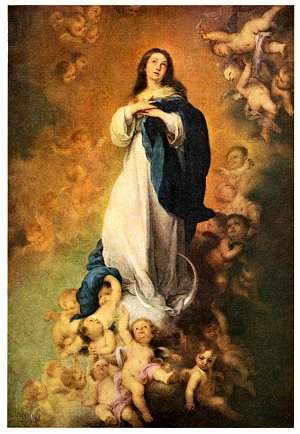
The Assumption of the Blessed Virgin Mary
1. It is generally believed that Our Blessed Lady died, since she would not have wished to escape death any more than her divine Son did. Our Lord, however, had seen her sharing in His agony and death upon Mount Calvary, and He willed that her own death would be so peaceful as hardly to justify the name.
The just die in the love of God and the martyrs died for the love of God. But Mary died consumed by the love of God. It was not disease which brought an end to her life, but love. Her love for Jesus was more ardent and more perfect than that of any other creature. She loved Him when she held Him in her arms in the stable at Bethlehem, when she fled with Him into Egypt, and when she offered Him in the temple to His heavenly Father. She loved Him when she found Him after He had been lost and when she looked after Him in their home at Nazareth. She loved Him as she followed Him to His death on Calvary. She loved him in the joy of His Resurrection and, subsequently, of His Ascension into Heaven. Jesus desired her to remain on earth for a while to comfort the infant Church and to initiate the loving patronage which she would exercise over it in Heaven. Her love grew from day to day until it entirely consumed her and her immaculate heart could no longer contain it. Mary fulfilled in a most perfect manner the Creator's command to His creatures to love Him with all their hearts and with all their strength. Consequently, her love reached such a peak that her soul in its final ecstasy glided from her body.
Let us ask our Mother, Mary, to help us to die with the love and grace of God in our hearts, and with the names of Jesus and Mary on our lips.
2. Even as Christ by His own power rose from the grave, so by reason of His intervention the soul of Mary was reunited, after a short separation, with her body, and she was taken up body and soul into everlasting glory. It was fitting that this privilege should have been bestowed on the Mother of God. It would have been unbecoming for the immaculate flesh in which the divine body of Jesus was formed to have been allowed to corrupt in the grave. It was fitting, too, that she who was to be proclaimed Queen of Angels and of men should have come immediately to her throne of glory with her humanity integral and unimpaired. Her resurrection was, moreover, the reward of her virginal purity. From the first moment of her conception she was preserved free from original sin and from every evil inclination, and throughout her life she had advanced farther and farther in the way of perfection.
We shall rise one day also, O Blessed Mother. Grant in your great love for us that we may so imitate your example as to deserve to rise in glory and to be associated with you in everlasting happiness.
3. After she had risen, Mary was gloriously taken up into Heaven. Jesus has ascended into Heaven by His own power, but Mary was borne aloft by the Angels, whose Queen she was soon to be proclaimed. She reigns in Heaven with her divine Son and looks down in love and mercy on her exiled children, whom she is ever ready to assist. She was the humblest and most exalted of creatures (Dante, Par. XXXIII, 2) for when told that she was to be the Mother of God, she desired to be called His handmaid.
Humility is the Mother of all the virtues even as pride is the source of all the vices. If we wish to share in Mary's triumph, we must first of all share in her humility.
“Everyone who exalts himself shall be humbled,” Jesus has said, “and he who humbles himself shall be exalted.” (Luke 14:11) “God resists the proud,” we are reminded by the Apostle James, “but gives grace to the humble.” (James 4:6) The glorious Assumption of Mary contains a lesson in humility for all of us.
Subscribe to:
Posts (Atom)