... or Hokey Pokey, as it's known elsewhere.
(This post is apropos nothing topical, just something I've long pondered on.)
When I was young, my dad told me the Hokey Cokey mocked the Mass. The words Hokey Cokey being based on "Hoc est enim Corpus Meum" ("This is My Body"). That seems to be a well known theory, although it has been denied (for example, here).
It might all be an urban legend, but...
When I started attending Traditional Latin Masses half my life (so far) ago, it started making sense.
You put your right hand in... out, shake it all about.
- Perhaps a parody of the priest making the sign of the cross over the host and chalice at the Offertory.
You do the Hokey Cokey
- As per the famous theory, as mentioned already, about it being a parody of "Hoc est emim Corpus Meum."
And you turn around
- Priest turns to congregation and says "Dominus vobiscum."
Knees bend
- Genuflection.
Arms stretch
- Elevation.
Rah rah rah!
- Bells rung thrice.
Can those similarities really have come about just by accident?
Showing posts with label liturgy. Show all posts
Tuesday, 11 August 2015
Tuesday, 4 August 2015
Things prophets haven't said
Traditionalist (and I number myself among them) often quote this:
We are what you once were.
We believe what you once believed.
We worship as you once worshipped.
If you were right then, we are right now.
If we are wrong now, you were wrong then.
But is it all that persuasive really?
There can't be many people who have difficulty conceding that they used to be wrong but that they're right now. If I were a modernist, and a traditionalist used that motto in a discussion with me, I'd probably respond, "Yes, I was wrong then. Now, I've seen the light!"
What might be a more persuasive argument?
Perhaps the fact that we have been warned to beware of novelties, in scripture for a start:
For there shall be a time, when they will not endure sound doctrine; but, according to their own desires, they will heap to themselves teachers, having itching ears: And will indeed turn away their hearing from the truth, but will be turned unto fables... - 2 Timothy 4:3-4
Notice the chronology. Truth first, being abandoned in favour of error. Not the other way round.
In fact, I don't think I've ever seen any prediction that says that one day the Church will start getting things right after having been wrong for so long. Not that anyone has to believe in private revelations, but when none of them predicts that things are just going to keep getting better in the Church, it should make one think.
These days, I'm more interested in what prophecies don't say than what they do. Things like, "There will be a great Council, that will open the Church up to the influence of the world, and there will be a new springtime!" And, "The Church's liturgy will undergo immense improvements, allowing more participation by the people, and more involvement of women, who have been neglected for so long." Not forgetting, "Church buildings will be greatly improved by the removal of altar rails, statues, and the relocation of tabernacles to a less central position."
So on the one hand, we've had warnings that things will become very bad (a diabolical disorientation, as Sr Lucy put it), and on the other we've had no predictions that things will get better (except after a chastisement of some kind). Our Lady's Immaculate Heart will triumph eventually, but meanwhile there will be trouble.
We are what you once were.
We believe what you once believed.
We worship as you once worshipped.
If you were right then, we are right now.
If we are wrong now, you were wrong then.
But is it all that persuasive really?
There can't be many people who have difficulty conceding that they used to be wrong but that they're right now. If I were a modernist, and a traditionalist used that motto in a discussion with me, I'd probably respond, "Yes, I was wrong then. Now, I've seen the light!"
What might be a more persuasive argument?
Perhaps the fact that we have been warned to beware of novelties, in scripture for a start:
For there shall be a time, when they will not endure sound doctrine; but, according to their own desires, they will heap to themselves teachers, having itching ears: And will indeed turn away their hearing from the truth, but will be turned unto fables... - 2 Timothy 4:3-4
Notice the chronology. Truth first, being abandoned in favour of error. Not the other way round.
In fact, I don't think I've ever seen any prediction that says that one day the Church will start getting things right after having been wrong for so long. Not that anyone has to believe in private revelations, but when none of them predicts that things are just going to keep getting better in the Church, it should make one think.
These days, I'm more interested in what prophecies don't say than what they do. Things like, "There will be a great Council, that will open the Church up to the influence of the world, and there will be a new springtime!" And, "The Church's liturgy will undergo immense improvements, allowing more participation by the people, and more involvement of women, who have been neglected for so long." Not forgetting, "Church buildings will be greatly improved by the removal of altar rails, statues, and the relocation of tabernacles to a less central position."
So on the one hand, we've had warnings that things will become very bad (a diabolical disorientation, as Sr Lucy put it), and on the other we've had no predictions that things will get better (except after a chastisement of some kind). Our Lady's Immaculate Heart will triumph eventually, but meanwhile there will be trouble.
Sunday, 2 August 2015
Whose preference?
The subject of the liturgy is often reduced to being a mere matter of preference, but isn't how we worship more significant than that?
One might prefer burger and fries to salad, but does that make it superior?
One could prefer the Beatles to Beethoven, while still acknowledging the superiority of the latter.
So, while one may "prefer" the New Mass or the Traditional Mass, which one is superior?
This post from last year might provide a clue.
Pomp need not come into it though. I maintain that a Traditional Mass, offered in the humblest of surroundings, without music, is still superior to a reverent New Mass in a cathedral.
(The Divine Liturgy is also superior. I often think of detergent adverts:
We washed the Latin Rite in new improved Vatican II, but we used the original formula on the
Eastern Rites. Let's see how they turned out!)
The changes matter. They matter to those who protest against them, and they matter to those who introduced them, otherwise they wouldn't have introduced them, imposing the new and suppressing the old.
The only preference which counts is God's preference. He "preferred" Abel's sacrifice to Cain's.
Tuesday, 20 May 2014
How St Pius V "imposed" his liturgical reform
I was just flicking through Msgr Klaus Gamber's The Reform of the Roman Liturgy, and came upon this interesting passage, on pages 25-26:
In the Middle Ages nearly every church, or at least every diocese, had its own special Missal unless it had voluntarily adopted the Missal of the Roman Curia. No pope intervened in this matter. The parts which, more than any other, were subject to variation, were those parts of the Order of the Mass said in a low voice by the celebrant (so, the prayers at the foot of the altar, the offertory - also called the Minor Canon - and the prayers before Communion); in other words, the priest's "private prayers." On the other hand, the sung texts were almost everywhere the same within the Latin Church. Only some of the readings and prayers differed from locality to locality.Contrast that approach with the imposition of Pope Paul VI's new liturgy.
It was at this stage of development that the defense against Protestantism brought about the Council of Trent. It entrusted the pope with the publication of an amended Missal uniform for all. What exactly did St Pius V do? As I have already said, he took the Missal already in use in Rome and in many other places and he improved it, especially by reducing the number of feasts of saints. Did he make this Missal obligatory for the whole Church? No, he even respected local traditions only two hundred years old. Such a tradition was sufficient to free a diocese from the obligation of using the "Roman Missal." The fact that, even so, the majority of dioceses very quickly adopted to new Missal is due to other causes. But Rome exercised no pressure - and that in an age during which, unlike today, there was no talk either of pluralism or of tolerance.
Wednesday, 7 May 2014
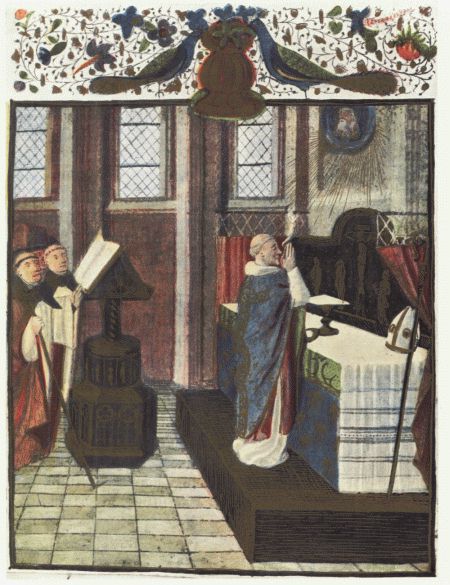
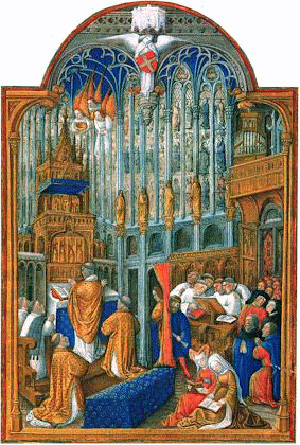
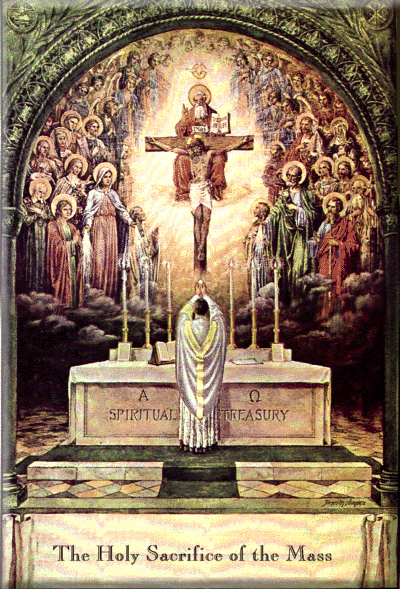
The Mass in art through the ages
(Edit: A friend observed that "through the ages" was perhaps a slight exaggeration, what with the images I found being mostly 20th century! So I'm adding some more, found by him, whom I thank.)
There have been some very powerful artistic depictions of the Mass over the years...

Hmmm. Res ipsa loquitur...
There have been some very powerful artistic depictions of the Mass over the years...
Hmmm. Res ipsa loquitur...
Wednesday, 26 February 2014
Reforming the Reform in three easy steps
1. Remove the elements of the New Mass that are not present in the Traditional Mass.
2. Reinstate the elements of the Traditional Mass that are not present in the New Mass.
3. Keep the elements of the New Mass that are present in the Traditional Mass.
Subscribe to:
Posts (Atom)